AI & Luxury Brands
AI Can Expand Your Thinking. It Cannot Own Your Judgment.
The real value of AI is not that it finishes your thinking. It gives your thinking more to fight with. The decision and the consequence remain human.

For 27 years, I have watched new tools arrive with the same promise: Everything will become easier. Some things did.
Photoshop made production faster. The internet made knowledge easier to reach. Prototyping tools made ideas easier to demonstrate. No-code platforms made building available to people who had previously been forced to use the phrase "development backlog” with a straight face.
Every tool removed work. The best tools also changed the work.
AI is doing both at a scale I have never seen before. It can write, analyse, summarise, translate, prototype, question, compare, and generate more options than any sensible person should request before breakfast.
Most companies are still using it as a very fast assistant. That is useful. It is also a waste.
If all you ask AI to do is shorten emails and tidy presentations, you have hired a telescope to read a restaurant menu. The bigger opportunity isn't faster production. It is expanded thinking.
A good machine gives you something to argue with
I do not get the most value from AI when I ask it for an answer. I get value when I ask it to show me the frame I am missing.
What assumption am I protecting? What would a customer misunderstand? How would a competitor attack this idea? What changes if we remove the feature everyone has already agreed is essential? What would someone from a completely different industry see here?
These questions turn AI from a production tool into a form of intellectual resistance.
It can remix patterns, expose alternatives, and travel through a field of possibilities faster than we can. That does not mean it has better instincts. It means it can place more material on the table.
Our job is still to decide what belongs there.
This distinction matters. An assistant helps you finish the task you already defined. A thinking partner can help you discover that you defined the wrong task.
That is where the interesting work begins.
Fluency is a very convincing costume
AI has one quality that makes it unusually persuasive: it rarely looks nervous.
It can be wrong in complete paragraphs. It can invent a fact, polish it beautifully, and deliver it with the confidence of the most senior person in the meeting.
Excellent punctuation is not evidence.
NIST describes this behaviour as confabulation: confidently presented false or erroneous content. The problem is structural. Language models are built to generate plausible continuations from patterns in data. Plausibility and truth often meet, but they are not married.
This creates an uncomfortable paradox.
When you know a subject deeply, AI's mistakes can be obvious. When you do not, its answer can feel complete precisely because you cannot see what is missing.
The less we know, the more impressive certainty can appear.
That is why AI literacy is not mainly about learning better prompts. It is about learning when not to trust a fluent answer.
AI can improve the work and flatten it
There is real evidence that generative AI can improve performance in bounded tasks. It can help people work faster, produce stronger drafts, and explore more directions.
But improvement has a shadow.
A 2024 experiment published in Science Advances found that access to generative-AI ideas helped participants produce stories judged to be more creative and enjoyable. It also made the stories more similar to one another.
That trade-off should matter to every designer, brand leader, recruiter, and founder.
AI can raise the floor while quietly lowering the distance between us.
When everyone uses similar systems, trained on overlapping material, guided by familiar instructions, competent work becomes abundant. The outputs improve, but their centre of gravity begins to converge.
This is why personal context becomes more valuable, not less.
Your history. Your cultural references. Your failures. Your humour. The client conversation that went badly in 2009 and still changes how you read a brief. The moment your child ignored the “intuitive” interface you had spent weeks perfecting.
The machine can find a pattern.
It cannot have your life.
Responsibility cannot be delegated to a prediction
The most important limitation of AI is not technical. It is moral and professional. A model can suggest a direction. It cannot own what happens after we choose it.
It will not sit opposite the client when a strategy fails. It will not watch a customer struggle with a product. It will not explain to a team why an automated decision treated someone unfairly. It will not carry the gap between what a brand promised and what the experience delivered.
We will.
Frameworks from NIST and the OECD make the same principle practical: organisations must define human oversight, decision rights, and accountability around AI systems. "A human reviewed it” is not enough if that human lacked the knowledge, authority, or time to reject the output.
Oversight only works when someone can say no.
My five-part rule for working with AI
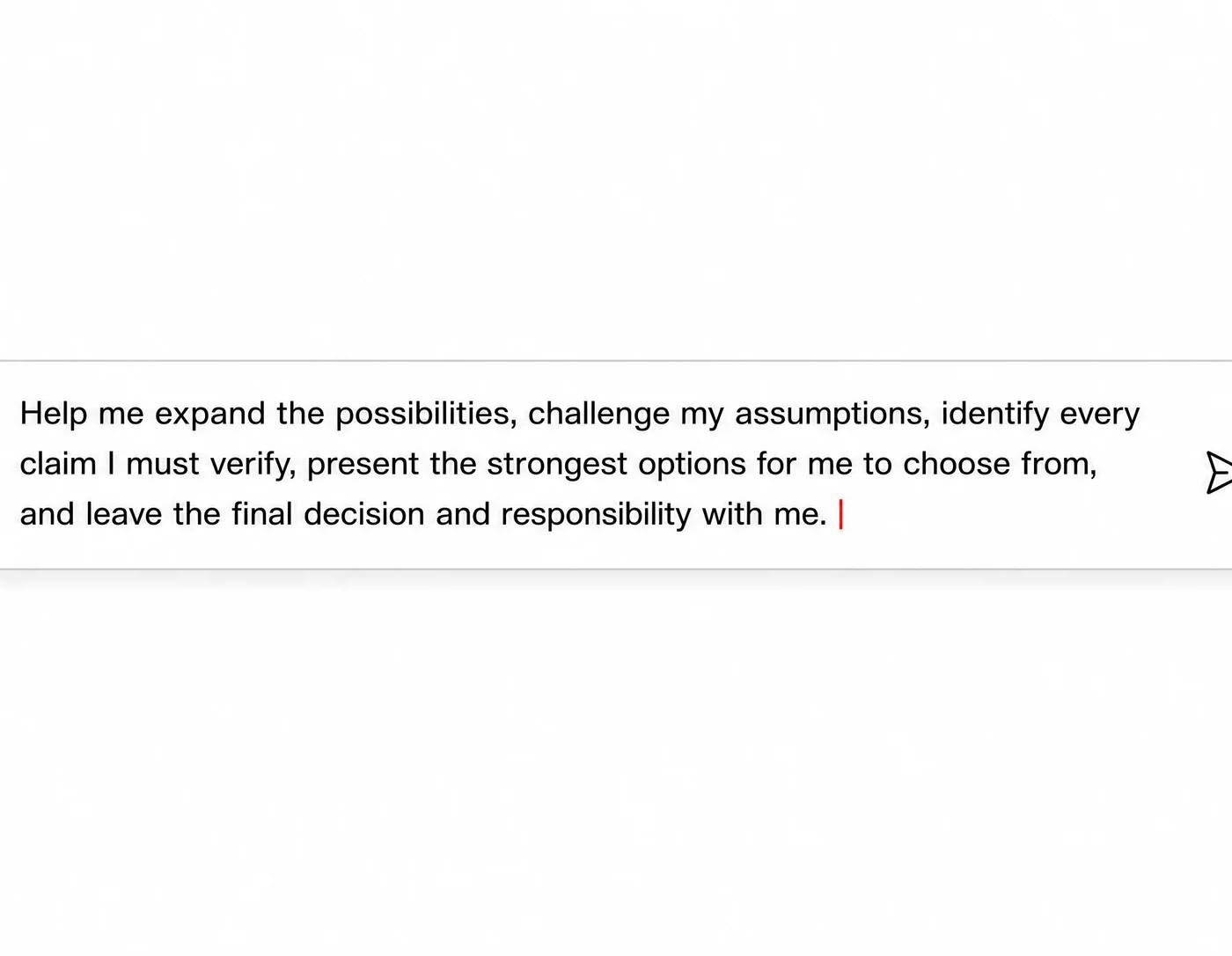
I use a simple sequence when AI enters serious creative or strategic work.
1. Expand
Ask for the directions you have not considered, including the uncomfortable and contradictory ones. Volume is useful at this stage because the purpose is to widen the field.
2. Challenge
Ask the system to attack the brief, the assumptions, and the preferred answer. Agreement feels efficient, but it rarely makes the work more intelligent.
3. Verify
Check names, dates, claims, quotations, numbers, and sources outside the model. If the information matters, confidence is irrelevant without evidence.
4. Choose
Selection is where experience becomes visible. Which direction is true to the objective? Which one serves the person on the other side? Which one is merely impressive?
5. Own
Put a human name next to the final decision. Not the name of the tool. The name of the person prepared to answer for the result.
This sequence keeps AI in the part of the process where it is strongest and keeps us in the part where we are necessary.
What this means for leaders and recruiters
The question “Do you know how to use AI?” is already too small.
Almost everyone will know how to generate something.
The more revealing questions are different.
How did AI change your original thinking? Which output did you reject? What did you verify? Where was the model confidently wrong? What standard did you apply when choosing the final direction?
For recruiters, these questions reveal judgment rather than tool familiarity.
For leaders, they reveal whether a team is using AI to think or simply to produce more material faster.
For brands, they reveal whether efficiency is strengthening the point of view or slowly replacing it.
The advantage is not the answer
AI will become faster, cheaper, and more capable. That is not a prediction requiring courage. It is already happening.
The human advantage will not come from competing with the machine on volume.
It will come from knowing what to ask, noticing what is absent, recognising what is wrong, and accepting responsibility for what is chosen.
Use AI to widen the room. Use it to challenge the comfortable answer. Use it to travel further than your first instinct. But do not ask it to own the destination. AI can expand your thinking. Your judgment is still the part with consequences.

Comments
Loading
Leave a comment